In 2021, Keytruda (pembrolizumab) became the highest-spending clinician-administered drug among the commercially insured population (people under age 65 covered through employer-sponsored insurance). Keytruda is an immune checkpoint inhibitor (anti–PD-1 monoclonal antibody) administered by infusion and used across a growing number of cancers, often in combination with chemotherapy or other agents and in both metastatic and earlier-stage disease.
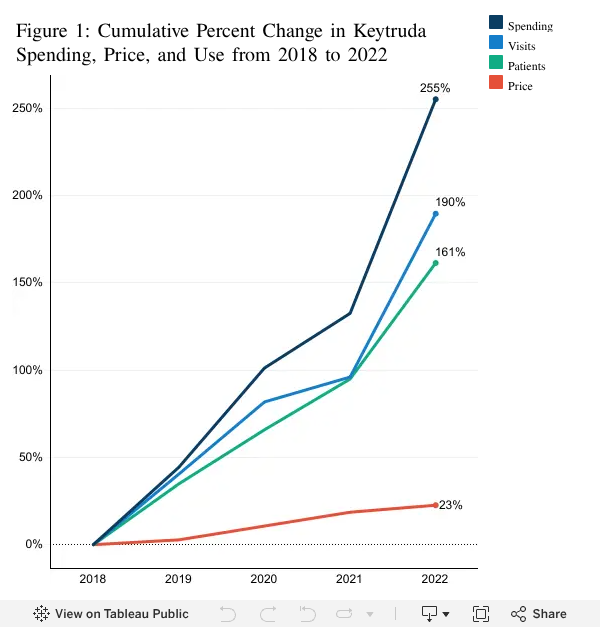
Total spending on Keytruda in this population more than tripled, increasing 255% from $1.1 billion in 2018 to $3.8 billion in 2022. This growth was driven primarily by increased utilization. The number of unique patients receiving Keytruda rose 161% from 12,000 in 2018 to 31,000 in 2022, and the number of Keytruda visits increased 190% from 64,000 to 184,000 over the same period. The average price for Keytruda increased 23%, with the average price per visit increasing from $16,780 in 2018 to $20,580 in 2022.
Shifts in treated cancer types align with expanding FDA-approved uses
Keytruda was first approved for melanoma and certain lung cancers starting in 2014, with additional approvals for cancers including bladder, gastric, and colorectal cancers in 2017 (SEER*Rx Interactive Antineoplastic Drugs Database).The increase in utilization is consistent with Keytruda’s expanding set of approved indications over time. Figure 2 shows that, in 2018, use of Keytruda was concentrated among people with cancer diagnoses that aligned with earlier approvals: 38.2% respiratory cancers, 10.5% melanoma/skin cancers, 7.3% digestive cancers, 3.1% urinary tract cancers, and 0.8% breast cancers.
By 2022, the distribution shifted substantially: 17.2% respiratory cancers, 6.8% melanoma/skin cancers, 5.3% digestive cancers, 10.4% urinary tract cancers, and 25.9% breast cancers. This change in patient mix is consistent with continued expansion of approved uses, including breast cancer approvals in 2020 and 2021. Importantly, the decline in the share of patients treated for lung or skin cancers does not necessarily indicate fewer patients treated for these cancers; because the total treated population grew sharply from 2018 to 2022, the absolute number of patients treated for these cancers remained stable or increased even as their percentage declined.

High spending reflects high per-visit prices and site-of-care differences
Although spending growth was driven mainly by greater use, overall spending levels remain high because Keytruda is expensive on a per-treatment basis. In 2022, the price per Keytruda visit exceeded $10,000 for nearly all providers and practice settings, and prices were consistently higher in outpatient hospital settings than in non-facility physician offices.
In 2022, the median price of a Keytruda visit in an outpatient setting was $21,594, compared to $11,506 in a non-facility office setting, as shown in Figure 2. Outpatient Keytruda visit prices ranged from $10,776 at the 10th percentile to $43,154 at the 90th percentile (the corresponding prices for a unit of Keytruda showed a similar distribution with a median price of $93 per unit, a price of $52 per unit at the 10th percentile and $163 per unit at the 90th percentile). Keytruda prices in non-facility physician offices ranged from $10,495 at the 10th percentile to $21,427 at the 90th percentile (the corresponding unit prices showed a similar distribution with a median price of $55 per unit, a price of $49 per unit at the 10th percentile and $75 per unit at the 90th percentile).

Approximately 60% of Keytruda treatments occurred in outpatient settings, and this share remained relatively stable from 2018 to 2022. Higher-priced outpatient site-of-care consistently accounted for a majority of visits during the study period, contributing to the overall high levels of spending that make Keytruda the top administered drug in terms of spending for the commercially insured.