
Commercially Insured
-
Commercial Prices Relative to Medicare Vary Within Metro Areas Across Specialties and by Type of Service
 Read more: Commercial Prices Relative to Medicare Vary Within Metro Areas Across Specialties and by Type of Service
Earlier HCCI research found that at the national level, commercial payers paid prices that were, on average, 122% of Medicare. However, we found that commercial professional service prices varied dramatically across states from 98% of Medicare in Alabama to 188% of Medicare in Wisconsin. There was similar variation within states, such as California, and also…
-
Charge Amounts for Professional Procedures to Commercial Insurance and Traditional Medicare
Read more: Charge Amounts for Professional Procedures to Commercial Insurance and Traditional MedicareIn the start of 2019, Centers for Medicare and Medicaid Services finalized federal policies that required hospitals to publish the amount they charge for common services, documents commonly referred to as chargemasters. While similar policies have been in place at the state level since the early 2000s, this was the first federal mandate to require…
-
ADRD Prevalence in Various Insurance Populations: A Collaboration with The Alzheimer’s Association
Read more: ADRD Prevalence in Various Insurance Populations: A Collaboration with The Alzheimer’s AssociationAlzheimer’s disease and related dementias (ADRD) represent a significant and growing cost to the United States health care system. While the prevalence and cost of ADRD related to Medicare Fee-for-Service beneficiaries is documented in the Center for Medicare and Medicaid Services’ Chronic Conditions Warehouse, less is known about the prevalence and cost of ADRD among…
-
Impact of New Technology on Prices and Use: A Case Examination of Robot-Assisted Surgeries
Read more: Impact of New Technology on Prices and Use: A Case Examination of Robot-Assisted SurgeriesSurgery accounts for the largest share of inpatient and outpatient spending among individuals with employer-sponsored insurance, representing 49 percent of inpatient spending and 37 percent of outpatient spending in 2018 according to HCCI’s most recent annual report. In recent years, the number of surgical procedures performed using robot assistance has increased dramatically. Intuitive, Inc., which…
-
Consumer-Directed Health Plan Enrollment Rises in All Cities over 10 Years (2008 to 2017)
Tags: 10 Year Trend, Commercially Insured, Consumer-Directed Health Plans, Geographic Variation, Out-of-Pocket, Spending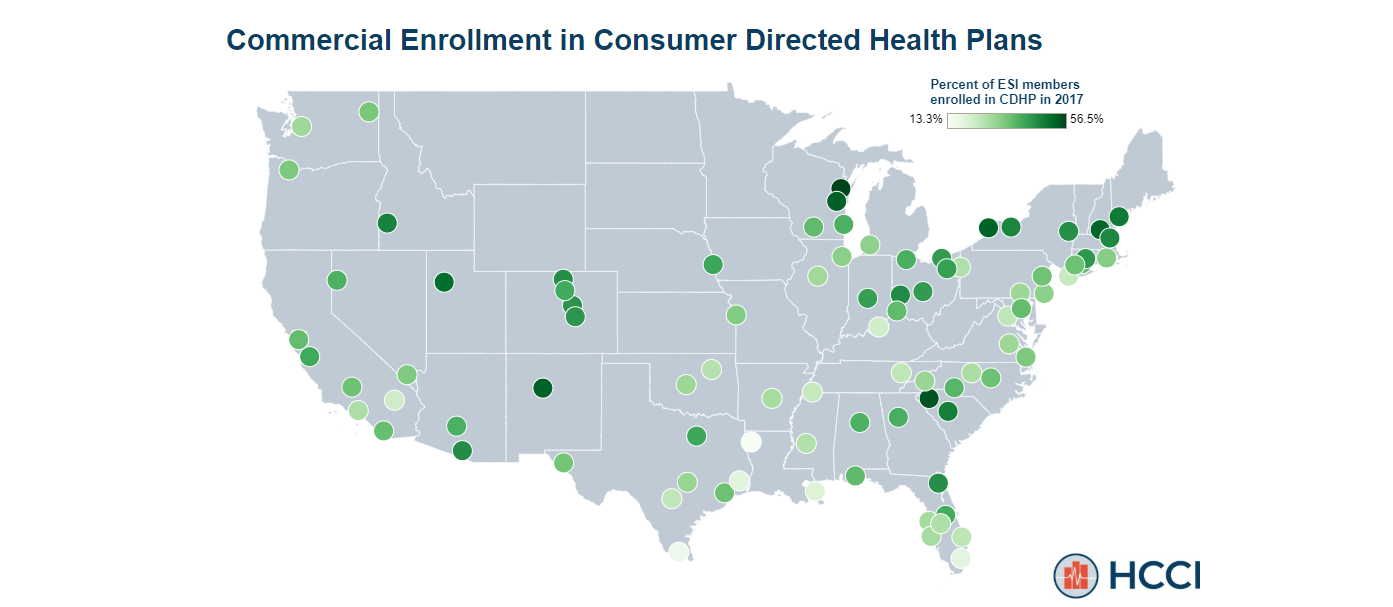 Read more: Consumer-Directed Health Plan Enrollment Rises in All Cities over 10 Years (2008 to 2017)
Recent analysis by HCCI finds that enrollment in consumer-directed health plans (CDHPs) increased dramatically since 2008. Nationally, nearly a third of commercially insured individuals were enrolled in a CDHP in 2017, up from 7.5% in 2008. Over ten years, enrollment in CDHPs doubled in 85 of the 88 metro areas studied. High-deductible health plans (HDHPs) have become increasingly common…
-
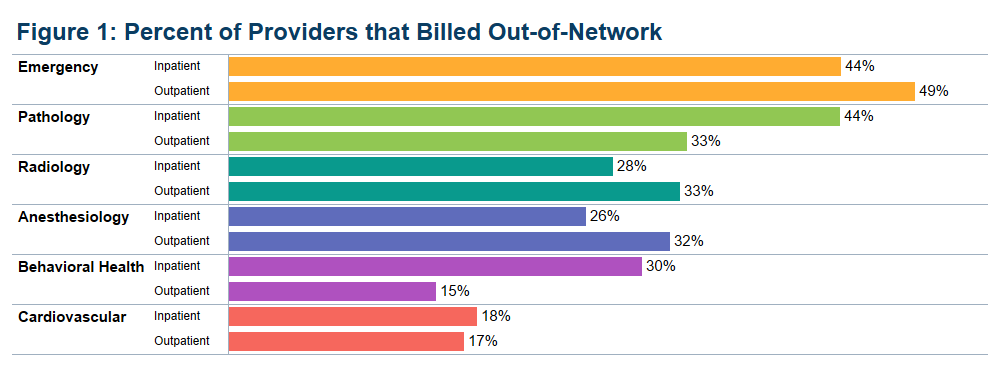
How often do providers bill out of network?
 Read more: How often do providers bill out of network?
In recent analysis, we document extensive variation across states and metropolitan areas in the frequency of out-of-network visits among individuals with health insurance provided by an employer. These differences raise the question of whether individual providers bill out of network at dissimilar rates. To explore whether a small group of providers are responsible for most…
-
Understanding Variation in Spending on Childbirth Among the Commercially Insured
 Read more: Understanding Variation in Spending on Childbirth Among the Commercially Insured
Childbirth is the most frequent reason for an inpatient admission in the United States, and Cesarean-section (C-section) is the most common operating room procedure in an inpatient hospital stay. Among people who get insurance through an employer, the combination of labor, delivery, and newborn care makes up nearly one in six dollars spent on inpatient…
-
Compared to What? Baseline Understanding of the Distribution of Hospital Care
Read more: Compared to What? Baseline Understanding of the Distribution of Hospital CareThe pandemic of a new coronavirus, COVID-19, is increasing demand on hospitals as unprecedented numbers of people with respiratory disease seek treatment. In addition to straining hospital resources directly related to care of COVID-19, the outbreak may also displace other types of care. In this analysis, we hope to inform the understanding of the distribution…
-
What if Price Transparency Reduced Commercial Price Variation?
 Read more: What if Price Transparency Reduced Commercial Price Variation?
As previous reports have indicated, there is widespread price variation in the U.S. commercial health care system. Many studies have shown that prices are dramatically different not only across geographies, but they vary substantially even within the same market for the same service. For example, we found that prices for the same blood tests could…
-
CMS-specified shoppable services accounted for 12% of 2017 health care spending among individuals with employer-sponsored insurance
Tags: Commercially Insured, Inpatient Spending, Out-of-Pocket, Outpatient Spending, Shoppable Services, UtilizationRead more: CMS-specified shoppable services accounted for 12% of 2017 health care spending among individuals with employer-sponsored insuranceIn response to high and growing health care spending, policymakers have proposed improving price transparency as a solution. Several such proposals rely on consumers taking action on publicly available information for shoppable services – generally, non-emergency services that a person could choose more deliberately. In 2021, hospitals will be required to display, in a consumer-friendly manner,…